Dog Age Calculator
How old is your dog in human years, really? Answer four quick questions and get the number, the life stage and a printable certificate. Free, no email needed.


How old is my dog in human years?
Your dog is about 15 human years old at age 1, 24 at age 2, and then gains 4 to 7 human years per calendar year depending on size: small dogs add 4, medium 5, large 6 and giant 7. A 5-year-old Labrador is therefore about 42; a 5-year-old Chihuahua about 36.
The old “multiply by seven” shortcut gets the first years badly wrong and the last years wrong in the other direction. The size-adjusted model used by the American Veterinary Medical Association and the American Kennel Club fixes both. Here is the short version; the full dog years chart runs to 20 years and five sizes.
| Dog’s age | Small 10–20 lb | Medium 21–50 lb | Large 51–90 lb | Giant over 90 lb |
|---|---|---|---|---|
| 1 year | 15 | 15 | 15 | 15 |
| 2 years | 24 | 24 | 24 | 24 |
| 3 years | 28 | 29 | 30 | 31 |
| 4 years | 32 | 34 | 36 | 38 |
| 5 years | 36 | 39 | 42 | 45 |
| 6 years | 40 | 44 | 48 | 52 |
| 7 years | 44 | 49 | 54 | 59 |
| 8 years | 48 | 54 | 60 | 66 |
| 9 years | 52 | 59 | 66 | 73 |
| 10 years | 56 | 64 | 72 | 80 |
| 11 years | 60 | 69 | 78 | 87 |
| 12 years | 64 | 74 | 84 | 94 |
| 13 years | 68 | 79 | 90 | 101 |
| 14 years | 72 | 84 | 96 | 108 |
| 15 years | 76 | 89 | 102 | 115 |
| 16 years | 80 | 94 | 108 | 122 |
Pick your dog’s breed in the calculator above and we deduce the size for you; for mixed breeds, the adult weight is enough. The result also shows a second number, the “science mode” estimate from a DNA study, and your dog’s life stage.
Why “multiply by 7” is wrong
Multiplying a dog’s age by 7 assumes dogs age at a constant rate, but they don’t: a 1-year-old dog is already sexually mature (about 15 in human terms, not 7), while a 12-year-old small dog is closer to 64 than 84. Dogs age fast early and slower later, and big dogs age faster than small ones.
The rule of seven dates from the 1950s, when people lived about 70 years and dogs about 10. It was never a biological finding. In 2020, researchers at the University of California San Diego compared DNA methylation in 104 Labradors with human samples and found the relationship is logarithmic: human age = 16 × ln(dog age) + 31 (Wang et al., Cell Systems). That curve says a 1-year-old dog is about 31 and a 10-year-old about 68. The AVMA table and the DNA clock disagree in the details, which is exactly why we show both.
How this calculator works
The calculator turns your dog’s exact age and size into human years in three steps: the first year counts as 15, the second adds 9 (to 24), and every year after that adds 4, 5, 6 or 7 depending on whether the dog is small, medium, large or giant. Puppies under a year are interpolated month by month.
- Breed sets the size. We look up typical adult weight for 236 breeds (toy under 10 lb, small 10 to 20, medium 21 to 50, large 51 to 90, giant over 90). Mixed breeds use the weight you give us, or the average of two parent breeds.
- Age becomes human years. The size model above gives the headline number. Science mode applies the UCSD logarithmic formula for dogs over 1 year.
- Lifespan sets the life stage. Using the AAHA Canine Life Stage Guidelines, your dog is a puppy under 1, a young adult until 3, a mature adult until 75 % of the expected lifespan for the breed or size, a senior for the last quarter, and geriatric beyond the average. Spayed and neutered dogs get one extra year of expected lifespan.
Dog life stages
Dogs pass through five life stages: puppy (under 1 year), young adult (1 to 3), mature adult (3 until about three-quarters of the expected lifespan), senior (the last quarter) and geriatric (beyond the average lifespan). Because lifespan depends on size, a Great Dane is a senior at 6 while a Chihuahua isn’t until 10.
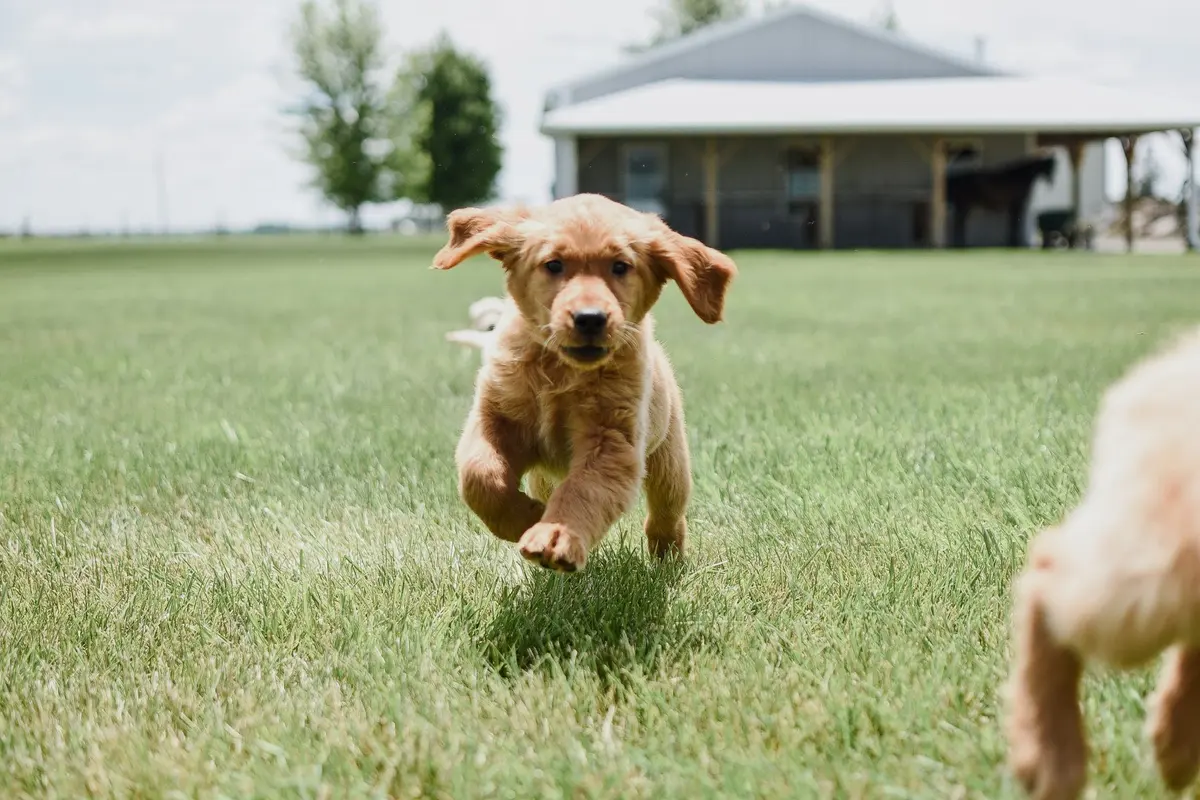
Puppy
Everything is new.
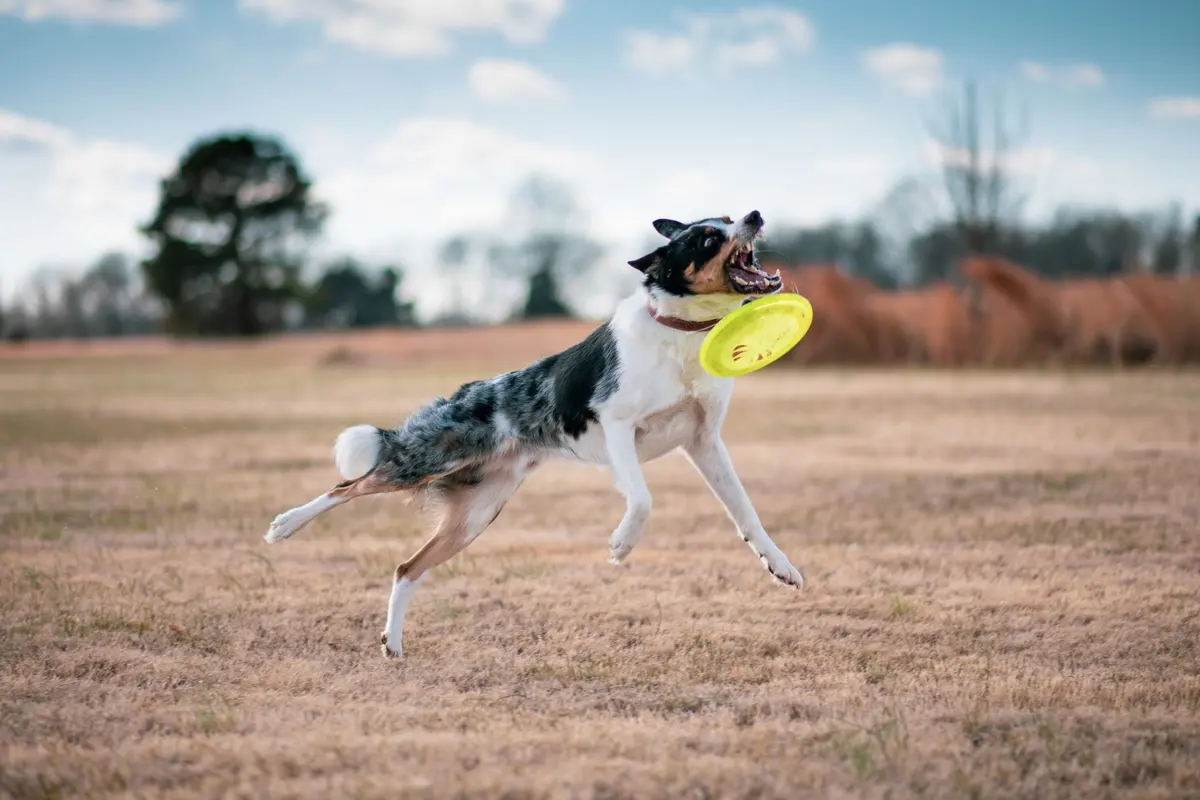
Young adult
Fully grown, full of energy and testing every boundary.

Senior
Grey muzzle, longer naps, a little stiffness getting up.
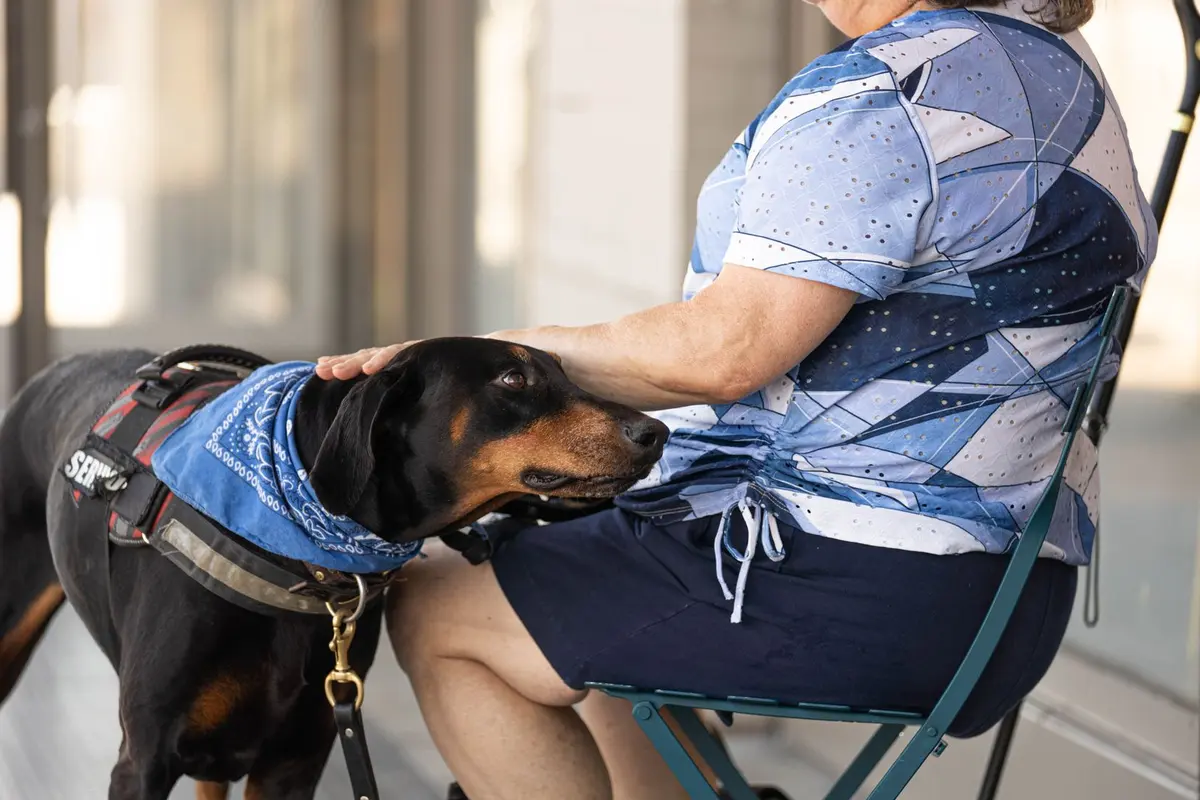
Geriatric
Every day is a bonus.
Small dogs vs big dogs: who ages faster?
Big dogs age faster and die younger. Giant breeds average 8 to 9 years, large breeds about 11, medium about 12 and toy breeds 14 or more. A 2013 study of 74 breeds found that each additional 4.4 lb (2 kg) of body mass shortens life expectancy by roughly a month, mostly through faster aging in adulthood rather than more puppy deaths.
The mechanism is still debated. Large dogs grow at an extraordinary rate, and that growth may carry costs: higher levels of the growth hormone IGF-1, more cell division, and a higher rate of cancer and joint disease. Whatever the cause, the pattern is strong enough that vets treat size as the main predictor of when a dog becomes a senior, which is why every number in this calculator changes with size after the second birthday (Kraus, Pavard & Promislow, The American Naturalist).

Get your dog’s age certificate
Once you have a result, you can turn it into a printable Official Dog Age Certificate: your dog’s photo in a gold-framed circle, the age in human years, the life stage, and “just for fun” comparisons in cat, elephant and tortoise years. It is generated on your device as a PDF, in US Letter or A4, in three styles.
Free, printable, yours in 60 seconds
Classic, Playful or Memorial style. The PDF downloads instantly; add your email and we’ll send a copy so it’s never lost.
Start with the calculator
Frequently asked questions
How old is 1 in dog years?
A 1-year-old dog is about 15 in human years, whatever its size. Dogs mature very fast in their first year: a 12-month-old dog is sexually mature and nearly full-grown, much like a mid-teenager.
How old is 10 in dog years?
A 10-year-old dog is roughly 56 human years if small, 64 if medium, 72 if large and 80 if giant. Small dogs age more slowly after their second birthday, which is why the gap widens with every year.
How many dog years is 1 human year?
It depends on the dog’s age. In the first year, one calendar year equals about 15 human years. In the second, about 9. From the third year on, each calendar year adds 4 (small dogs) to 7 (giant dogs) human years.
Is a 7-year-old dog a senior?
Only for giant breeds. A 7-year-old Great Dane is a senior (about 59 in human years), but a 7-year-old Beagle is a mature adult (about 49) and won’t be a senior until around 9. Small dogs reach senior status closer to 10.
Do small dogs live longer?
Yes. Toy and small breeds average 13 to 14 years, medium dogs about 12, large dogs about 11 and giant breeds only 8 to 9. Kraus et al. (2013) found that every 4.4 lb of body mass costs a dog about one month of life expectancy.
Is the dog age calculator accurate?
It is the best available estimate, not a medical measurement. Our primary model is the size-adjusted table used by the AVMA and AKC; the “science mode” number comes from the 2020 UCSD epigenetic study. Breed, genetics, weight and care all shift the real number.
How do I know my rescue dog’s age?
Teeth are the best clue: all adult teeth by 7 months, slight wear by 2 years, tartar on the back teeth by 3 to 5, and heavy wear or missing teeth after 10. Cloudy eyes after 7 and a grey muzzle after 6 to 8 help too. See our guide to telling a dog’s age.
Are cat years the same as dog years?
No. Cats age like small dogs: about 15 human years at age 1, 24 at age 2, then 4 human years per calendar year. Cats aren’t size-dependent, so a 10-year-old cat is about 56 whatever the breed. Try the cat age calculator.
Medically reviewed by our reviewing veterinarian, DVM · September 2026 Formulas, life stages and health notes follow AVMA, AKC and AAHA guidance. How we review · Not a substitute for veterinary advice.


